It’s fascinating to watch your hens start to lay eggs, but I was a little nervous to leave them on my kitchen counter. I had no idea how long they could stay fresh without spoiling.
Then a neighbor with a small flock told me something that changed my mind. Fresh eggs straight from the coop are made to sit out for a while. Nature built them that way.
In this guide, I will show you how long fresh chicken eggs last on the counter. You will learn why some eggs last two weeks and others only two days. You will also learn how to check if an egg is still good, and the best way to store your eggs.
Unwashed fresh eggs can sit on your counter for about 2 weeks. Some last 3 or 4 weeks if your kitchen stays cool. Washed eggs should only stay out for about 2 hours, then they need to go in the fridge.
That is the quick answer. But the real answer depends on a few things:
- Whether the egg has been washed
- How warm your kitchen is
- How fresh the egg was when you collected it
- How clean the shell and the nesting box were
Why Can Fresh Eggs Sit Out at All?
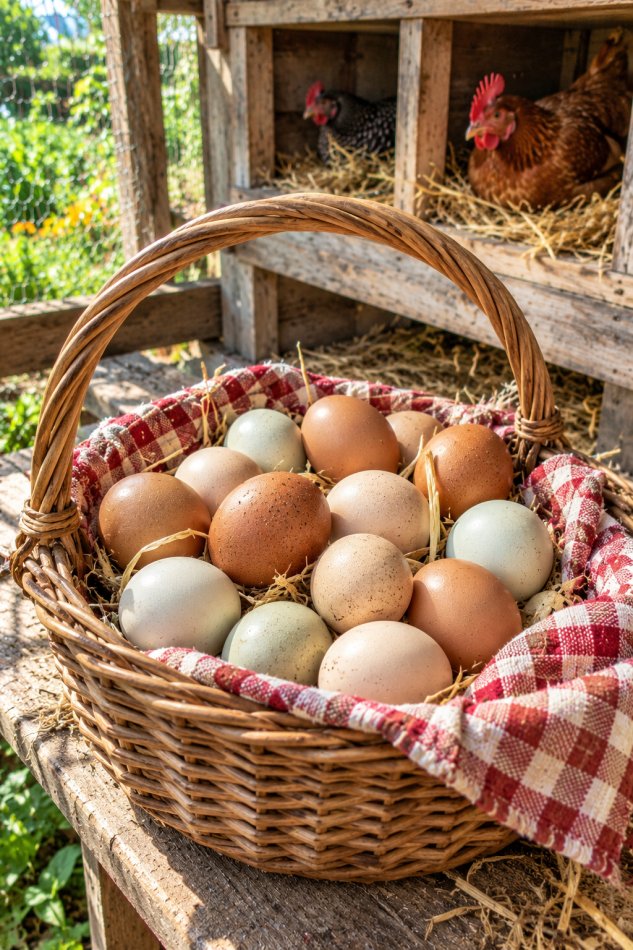
When a hen lays an egg, she does something clever. Just before the egg leaves her body, she covers the shell with a thin, wet layer called the bloom. You may also hear it called the cuticle.
This layer dries almost right away. It seals the thousands of tiny holes in the shell.
Those holes are why eggs can be risky when the bloom is gone. Air and water can pass through them. So can germs.
The bloom works like a natural raincoat. It keeps germs out and keeps moisture in. As long as it stays on the shell, the egg is well protected.
This is why farmers have kept eggs in baskets, bowls, and crates for many years. They had no choice, and it worked.
There is also a second layer of protection inside. The egg white has natural stuff in it that fights germs. The shell, the thin skins inside, and the white all work together like a team.
Also Read: How Many Eggs Does a Chicken Lay Each Day?
Washed vs. Unwashed Eggs: The Biggest Factor
If you remember only one thing from this article, remember this. Washing an egg removes the bloom.
Once the bloom is gone, the holes are open. Germs can get in much more easily. The egg also loses moisture faster.
So a washed egg is not the same as an unwashed egg, even if they came from the same hen on the same morning.
Unwashed eggs (bloom still on):
- Safe on the counter for about 2 weeks at normal room temperature
- Can last 3 to 4 weeks if kept in a cool spot
- Can last many months in the fridge
Washed eggs (bloom removed):
- Safe on the counter for about 2 hours
- Should go straight into the fridge
- Last about 4 to 5 weeks in the fridge
This is also why store-bought eggs in the United States must stay cold. Big farms there are required by law to wash their eggs. That removes the bloom, so the cold case is the only protection left.
In many other countries, like the UK and much of Europe, eggs are not washed. You will often see them on regular shelves in shops. Same eggs, different rules.
How Long Eggs Last on the Counter?
Here is a simple guide you can come back to. These numbers are general, and your kitchen temperature matters a lot.
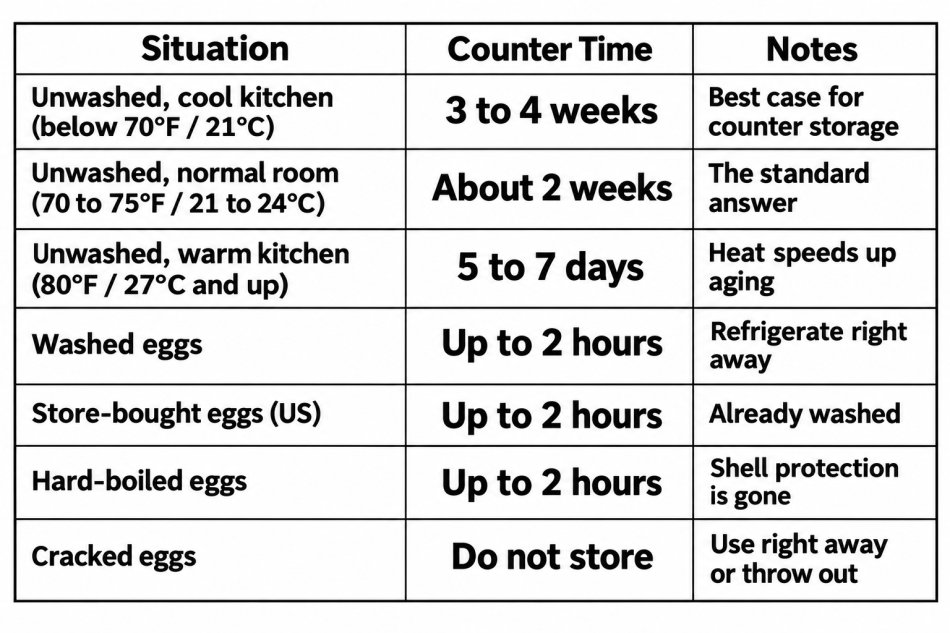
Think of these as safe windows, not strict deadlines. The cooler and cleaner your setup is, the more time you have.
How Temperature Changes Everything?
Heat is the enemy of a fresh egg. Warm air helps germs grow faster. It also makes the egg lose moisture and quality sooner.
An egg in a 65°F (18°C) kitchen is in a very different spot from an egg in a 90°F (32°C) kitchen. The first one might stay good for a month. The second one might be questionable after a week.
A steady temperature matters too. Eggs do best when the temperature stays about the same. A spot that is cold in the morning and hot in the afternoon is not ideal.
A few places to avoid:
- Next to the stove or oven
- Near a sunny window
- On top of the fridge, where warm air from the motor rises
- Close to the dishwasher or any other appliance that makes heat
A shaded corner of the counter, away from appliances, is usually a safe choice. A pantry shelf is even better.
Also Read: Why Did My Chickens Stop Laying Eggs?
What About Hot Climates?
If you live somewhere hot, the rules change a little. I know many readers have kitchens that sit at 30°C (86°F) or higher for months.
In that kind of heat, I would not trust the 2 week rule. Plan on 5 to 7 days at most. Honestly, the fridge is the safer choice.
Here is what helps in hot weather:
- Keep eggs in the coolest room of the house
- Store them in a clay pot or an open container, away from direct sun
- Use the oldest eggs first
- Check eggs more often, and do the float test before cooking
Humidity matters too. Very damp air can cause mold on the shell. If you see fuzzy spots or smell something musty, move your eggs to the fridge.
How to Tell If an Egg Is Still Good?
You do not have to guess. There are a few easy checks that work well, and I use them all the time.
The Float Test
This is the most popular method. It works because of air.
Over time, an egg loses moisture through its shell. Air takes its place, and the air pocket inside gets bigger.
To do the test, fill a bowl or glass with cool water. Gently place the egg inside.
- Sinks and lies flat on its side: Very fresh. Great for frying, poaching, and boiling.
- Sinks but tilts or stands on one end: Older, but still good. Use it soon. These are easier to peel when boiled.
- Floats to the top: Too much air has built up. Throw it away.
One small warning. A floating egg is a clear sign to toss it. But a sinking egg is not a full guarantee. Always do one more check.
The Smell Test
Crack the egg into a separate small bowl, not straight into your pan or batter. Then smell it.
A good egg has almost no smell. A bad egg has a sharp, rotten smell that you cannot miss. If anything smells off, throw it out.
Using a separate bowl also saves your recipe. One bad egg will not ruin your cake batter.
The Look Test
Once the egg is cracked, look at it closely.
A fresh egg has a thick, rounded white and a firm, bright yolk that sits up high. An older egg has a thinner, runnier white that spreads out wide, and the yolk looks flatter.
Thin and runny does not always mean unsafe. It just means the egg is getting older. But watch for these warning signs:
- A pink, green, or bluish tint in the white
- Dark spots or cloudy patches that look like mold
- A slimy or powdery shell
- Any sour or rotten smell
If you see any of these, do not eat the egg.
The Shake Test
Hold the egg close to your ear and shake it gently. A fresh egg stays quiet. If you hear sloshing, the inside has gotten loose, which means the egg is old.
This one is not as reliable as the float test. I use it as a quick extra check when I am not sure.
Also Read: How Do I Ferment Chicken Feed for Healthy Hens & Eggs?
Best Way to Store Eggs on the Counter
A few simple habits can add days or even weeks to the life of your eggs. Here is what I do in my own kitchen.
1. Do Not Wash Them Until You Use Them
This is the golden rule. Leave the bloom alone.
If an egg has a little dirt or a feather stuck to it, try to brush it off with a dry cloth, a soft brush, or fine sandpaper. Save the wet rinse for right before you crack the egg.
2. Store Them Pointy End Down
The air pocket sits at the wide end of the egg. When the pointy end faces down, the yolk stays in the middle and the air pocket stays away from it.
This helps the egg stay fresh longer. It also keeps the yolk from touching the shell, where germs can reach it more easily.
3. Use a Good Container
A wire basket, a wooden bowl, or a ceramic egg holder looks lovely on the counter. Just make sure air can move around the eggs.
An egg carton works well too. Cartons protect the shells from cracks and from picking up strong smells.
4. Pick a Cool, Dry, Shaded Spot
Skip the sunny windowsill, even if it looks pretty in photos. A quiet corner of the kitchen or a cool pantry is a much better home.
5. Keep Track of Dates
Write the collection date on the egg with a pencil. Or write it on the carton.
Then use the oldest eggs first. It sounds simple, but it stops a lot of waste.
6. Start With Clean Eggs
Eggs from a clean nesting box start out with better protection. Change the bedding often, collect eggs every day, and gather them early in the morning.
Collecting daily also keeps eggs from sitting in a warm coop, which can shorten their life before they ever reach your kitchen.
What If the Egg Is Dirty When You Collect It?
This happens to every backyard keeper. A hen steps in mud, and the egg comes out with a smear on it.
If the egg is only a little dirty, dry cleaning is the way to go. Use a dry cloth, a soft brush, or a piece of fine sandpaper to gently rub the spot off.
If the egg is very dirty, you have two choices:
- Wash it in warm water and put it in the fridge right away. Use it within a few weeks.
- Use it first, before any of your clean eggs.
When washing, always use water that is warmer than the egg. Cold water can pull germs through the holes as the egg cools and shrinks. Aim for water around 90 to 100°F (32 to 38°C), and dry the egg right after.
Once washed, that egg lives in the fridge. Do not put it back on the counter.
Counter vs. Fridge: Which Is Better?
There is no single right answer. It depends on your eggs, your kitchen, and how fast you eat them.
The counter makes sense when:
- Your eggs are unwashed and the bloom is still on
- Your kitchen stays cool
- You use your eggs within a week or two
- You have a small flock that gives you a few eggs a day
The fridge makes sense when:
- Your eggs are washed or store-bought
- Your kitchen is warm or damp
- You have more eggs than you can use quickly
- You want your eggs to last 2 to 3 months or longer
Many people do both. I keep a small bowl on the counter with the eggs I will use this week. The rest go in the fridge in cartons.
It is a simple system, and it makes my kitchen feel like a real home.
Never Move Eggs Back and Forth
Here is a mistake that catches many people. Once an egg has been in the fridge, do not put it back on the counter for long-term storage.
When a cold egg sits in a warm room, tiny drops of water form on the shell. This is called condensation. That water can carry germs through the holes and into the egg.
A chilled egg also loses the protection it had when it was fresh. So the safe move is to keep it in the fridge until you cook it.
If you need eggs for baking, let them warm up for a short time. Then use them the same day.
How Long Do Eggs Last in the Fridge?
For comparison, here is how long eggs usually last when stored cold.
- Fresh, unwashed eggs: 2 to 3 months, sometimes longer
- Washed eggs: 4 to 5 weeks
- Store-bought eggs: 3 to 5 weeks past the pack date, often longer
- Hard-boiled eggs in the shell: Up to 1 week
- Cracked raw eggs in a sealed container: 2 to 4 days
Keep your fridge at 40°F (4°C) or colder. Store eggs on a middle shelf, not in the door, because the door gets warm every time you open it.
Also keep them away from strong foods like onions or fish. Shells have tiny holes, so eggs can pick up smells.
Ways to Make Fresh Eggs Last Even Longer
If your hens lay more eggs than you can eat, you have some options. Here are a few old and new ways.
Mineral Oil Coating
Rubbing a thin layer of food-grade mineral oil on a clean, dry shell works like a new bloom. It seals the tiny holes again.
Oiled eggs can last much longer in storage. It is a good trick for people who wash their eggs but still want them to last longer on the counter.
Water Glassing
This is an old method that people used long before refrigerators. Unwashed eggs are kept in a lime water mix, which seals the shells and keeps germs out.
It works well for people who get lots of extra eggs in spring and summer. Hens lay less in winter, so many homesteaders stock up ahead of time.
It takes some care, so follow a trusted recipe closely if you try it.
Freezing
You can freeze raw eggs for up to a year. Crack them, beat them lightly, and pour them into ice cube trays or freezer bags.
Do not freeze eggs in the shell. The liquid grows bigger when it freezes and cracks the shell.
Frozen eggs are great for baking and scrambled eggs. Write the date and the number of eggs on the bag.
Pickling
Hard-boiled eggs can be pickled in a vinegar mix and kept in the fridge. It makes a tasty snack and uses up extra eggs.
Is It Safe? Understanding Salmonella
Let me be honest about the risk. Salmonella is the main worry with eggs. It can be on the outside of the shell, and sometimes inside the egg.
The risk is fairly low, but it is real. Small flocks that are kept clean and healthy usually have a lower risk than big factory farms. Still, no flock is risk free.
Here are some simple habits that keep your family safe:
- Wash your hands after touching eggs or handling hens
- Cook eggs until the whites and yolks are firm
- Do not use cracked or dirty eggs raw
- Keep the coop clean and dry
- Take extra care when serving eggs to babies, older adults, pregnant women, or anyone who gets sick easily
If you are cooking for someone in one of these groups, the smartest choice is to use eggs from the fridge and cook them fully.
Common Mistakes to Avoid
I have made a few of these myself. Learn from my slip-ups.
- Washing eggs right after collecting them. This removes the bloom and shortens their counter life.
- Leaving eggs in the coop for days. Heat and dirt shorten their life.
- Storing them near the stove. Even a little heat adds up.
- Mixing old and new eggs with no dates. You will forget which is which.
- Trusting only the float test. Use your nose and eyes too.
- Putting fridge eggs back on the counter. Condensation can let germs in.
- Ignoring cracks. Even a hairline crack is enough to let germs in.
Conclusion
Fresh, unwashed eggs last about 2 weeks on the counter in a normal kitchen, and up to 3 to 4 weeks in a cool spot. Washed eggs are different: they need to go in the fridge within 2 hours.
The secret is the bloom, the natural coating on the shell. Protect it, and your eggs protect themselves.
Store eggs pointy end down, keep them cool and out of direct sun, and write the date on each shell. Before cooking older eggs, do the float test and give them a quick sniff.
If you live in a hot climate, play it safe and use the fridge. And if you’re ever unsure, throw the egg out. A cracked egg costs a few cents, but a bad one can cost you days of feeling sick.
A bowl of fresh eggs on the kitchen counter feels slow, simple, and a little old fashioned. With these tips, you can enjoy that feeling and stay safe too.


Khaja Moinuddin, a computer science graduate, finds joy in gardening and homesteading. Join him on this blog as he shares his experiences in homesteading, gardening, and composting