If you think you can feed your chicken the leftover bread from the kitchen, then think twice, especially if that bread has even a tiny spot of mold.
Mold can produce natural poisons called mycotoxins, and these can harm a chicken’s liver and kidneys, slow growth, and cut egg production.
Here’s the tricky part. Extension experts point out that seeing mold doesn’t prove a toxin is present, and clean-looking feed isn’t always free of toxins. Only lab testing can tell for sure. With a fuzzy slice of bread, you can’t know what’s in it, so it isn’t worth the gamble. Source
Young birds are at the highest risk. Research reviews say young poultry are more sensitive to aflatoxin and ochratoxin than adults. In young chicks, ochratoxin A is about three times more toxic than aflatoxin.Source
I know it hurts to toss bread when hungry hens are waiting at the fence. This guide explains what moldy bread does to chickens, what to do if yours already ate some, and how to use leftover bread safely.
Never feed bread with visible mold, a musty smell, or a slimy feel. Fresh or stale bread with no mold is fine in small amounts as an occasional treat.
Bread isn’t very nutritious for chickens, so it should never replace their complete feed.
Why Moldy Bread Is Dangerous for Chickens?
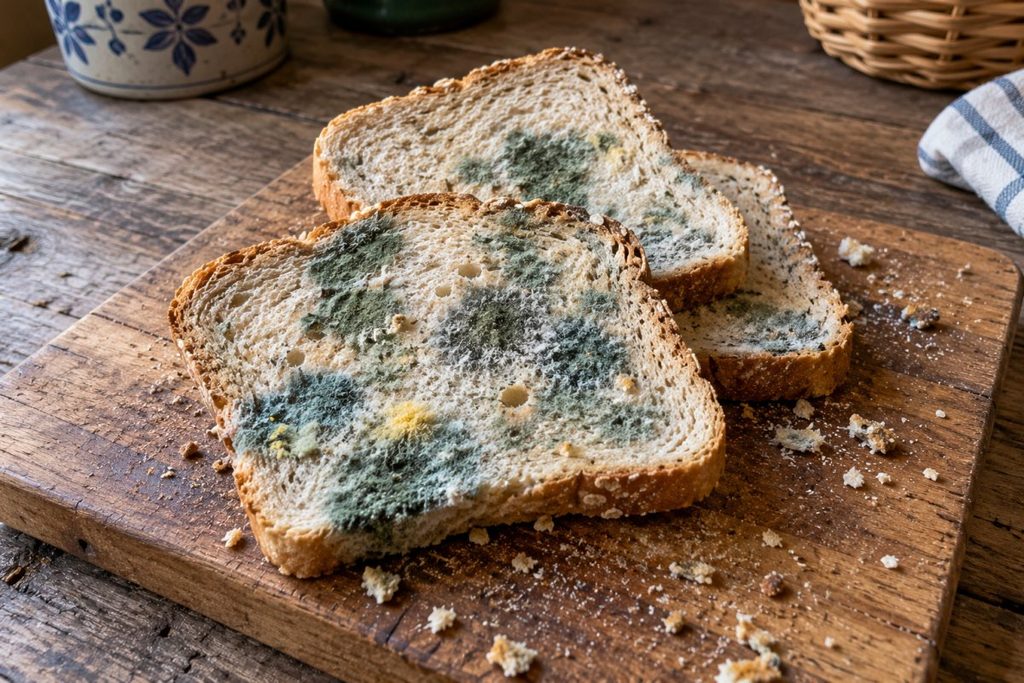
Mold is a fungus. When it grows on food, some types make mycotoxins. Not every mold does. Most fungi don’t produce mycotoxins, and some molds simply spoil food. But bread is a common home for molds like Penicillium and Aspergillus, and some molds in these groups do make toxins.
The problem is you can’t tell which is which by looking. That’s why the safest rule is to treat all moldy bread as a risk.
Mycotoxins are also tough. Many are chemically stable and keep their toxicity over time, so toasting, drying, or crumbling the bread won’t make it safe.
Two toxins get the most attention in poultry.
Aflatoxin: Made by Aspergillus molds, it mainly affects the liver. Chickens are considered relatively resistant, so sudden poisoning is rare, but eating it for several weeks can cause long-term problems.
Ochratoxin A: This one mainly targets the kidneys and is linked to poor feed use and weak eggshells.
Toxins can also team up. When several mycotoxins are eaten together, they can combine to cause worse symptoms.
Even small doses can cost you. Low levels usually cause quiet problems like eating less and poorer egg quality, and the bird may not look sick at all. Reviews also note that toxins can leave residues in poultry meat and eggs.
Also Read: 70 Things Chickens Can Eat & 30 Food Items to Avoid
Can You Just Cut Off the Moldy Part?
No. The mold you see on the surface is only the visible part. Bread is soft and porous, so mold threads spread through the slice before you notice them. Toxins can spread with them. Cutting off a green spot and feeding the rest isn’t safe.
Signs of Mold Poisoning in Chickens
Symptoms vary, and they can look like other problems. Experts say there is no single symptom, but the more symptoms you see, the more likely mycotoxins are the cause. Watch for these.
- Eating less: Hens that suddenly ignore feed or treats may be feeling off.
- Slow growth in chicks: Chicks that fall behind others the same age are a red flag.
- Loose droppings: Diarrhea or watery droppings can be an early sign.
- Egg changes: Fewer eggs, smaller eggs, or thin, weak shells.
- Low energy: Ruffled feathers, weakness, or a hen that stays by herself.
What to Do If Your Chickens Ate Moldy Bread?
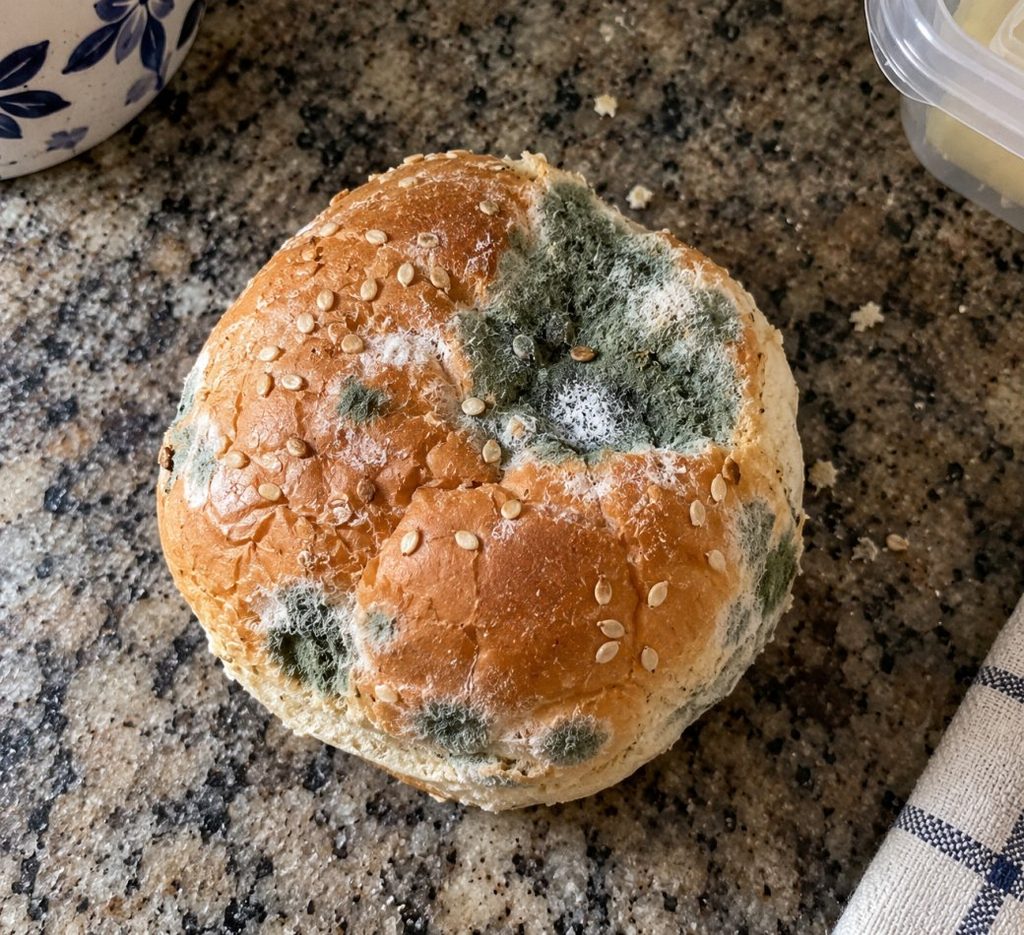
Don’t panic. A one-time nibble often causes no problem, especially in healthy adult hens. Here’s what to do.
- Remove the bread: Pick up every bit, including crumbs. Check the run for scraps.
- Switch to clean feed and fresh water: Offer their regular complete feed and clean water right away.
- Watch them for a few days: Look for the signs above, especially in chicks.
Call a vet if they look sick: Medicine doesn’t cure this. Antibiotics and other drugs aren’t effective against mycotoxin poisoning, so care is mostly about clean feed and support. A vet can guide you on that.
The good news is that recovery is common. One poultry health guide says most chickens recover within about three weeks once contaminated food is removed and clean food is provided. If chicks ate a lot, don’t wait. Call a vet sooner.
Check this: 20 High Protein Chicken Feed to Boost Its Growth
Can Chickens Eat Fresh or Stale Bread?
Yes, in small amounts. Chickens enjoy bread, and it’s a handy way to use up leftovers. Stale bread is fine as long as it’s dry and has no mold. Stale does not mean moldy.
But bread isn’t a great food for them. It’s mostly carbs, with little protein, and it fills them up fast. That can crowd out the feed that has everything they need. As we covered in the protein sections above, chickens need steady protein for growth, feathers, and eggs.
A good rule is to keep all treats to about 10% of the daily diet. Whole grain bread is a little better than white. Crumble it into small pieces, and give only what they’ll finish in a few minutes.
Breads to Skip
Some bread is a no, even when it’s fresh.
Salty or seasoned bread: Garlic bread, cheesy bread, and anything with a lot of salt or spices.
Sweet or chocolate bread: Chocolate is toxic to chickens, and too much sugar isn’t good for them.
Raw dough: It can swell in a chicken’s crop and cause serious trouble. Never feed it.
How to Spot Moldy Bread?
Check both sides of every slice, plus the crust and the corners. Moldy bread may have:
Fuzzy spots: They can be green, blue, white, gray, or black.
A musty or sour smell: If it smells off to you, it’s off for them too.
Damp or slimy patches: Moisture often means mold is starting.
If one slice has mold, throw out the whole loaf. Spores spread easily inside a bag, especially in warm, humid weather.
Safe Ways to Use Leftover Bread
Freeze extra bread: Slice and freeze it, then thaw a few pieces at a time.
Crumble it small: Mix it with their regular feed or scatter it on the ground.
Pick up leftovers: Remove any uneaten bread within an hour, so it doesn’t turn into a mold farm in the run.
Skip the soaking: Wet bread molds fast, especially in warm weather.
Better Treats Than Bread
If you want to spoil your flock, there are far better choices. Cooked eggs, oats, sunflower seeds, peas, and mealworms all give chickens more nutrition than bread does. Fresh greens and garden scraps are also great. Save the bread for the occasional treat.
How to Prevent Mold in Your Coop?
Mold doesn’t only come from bread. Experts note that feed is the key way mycotoxins get into a poultry flock. A few habits keep your coop safer.
- Store feed properly: Keep it in a dry, sealed bin with a tight lid. Buy only what your flock will finish in a few weeks.
- Keep feeders dry: Clean them often, and don’t leave wet feed sitting out.
- Fix leaks and damp spots: Wet bedding and leaky feeders grow mold fast.
- Take extra care in wet weather: Mold risk goes up in humid or rainy seasons.
- Throw out suspect feed: If it’s clumpy, musty, or discolored, don’t feed it.
Also Read: How to Care for Chickens in the Winter?
Frequently Asked Questions
Can chickens eat a little moldy bread?
It’s best not to. One small nibble by a healthy adult hen may not cause harm, but there’s no safe amount, and toxins can build up with repeated exposure.
Is moldy bread worse for chicks?
Yes. Chicks are more sensitive to mycotoxins than adult birds, so keep any moldy food far away from them.
Can ducks eat moldy bread?
No. Ducks are even more sensitive. Reviews say ducks are about 10 times more sensitive to aflatoxin than chickens.
Are the eggs safe if my hens ate moldy bread?
A single nibble is unlikely to be a concern. If your hens ate a lot, or they look sick, check with a vet before you eat the eggs.
What should I do with moldy bread?
Put it in the trash, or in a compost pile your chickens can’t reach.
Conclusion
Chickens shouldn’t eat moldy bread. You can’t see mycotoxins, you can’t cook them away, and they can hurt your flock’s health and egg laying, especially chicks.
Fresh or stale bread with no mold is fine as a small treat. When in doubt, toss it out, and reach for a healthier treat instead. A little caution now saves you a lot of worry later.


Khaja Moinuddin, a computer science graduate, finds joy in gardening and homesteading. Join him on this blog as he shares his experiences in homesteading, gardening, and composting